Cloud-Native Had Kubernetes. AI-Native Needs ModelSpec
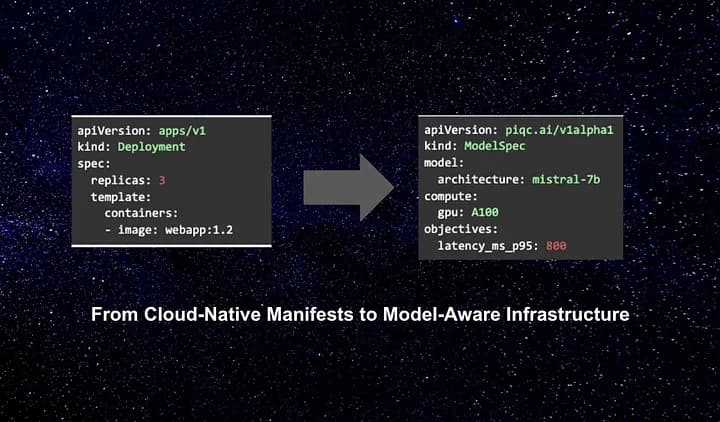
For anyone who lived through the rise of cloud-native, the pattern unfolding in AI today feels familiar. The turning point in cloud-native was a specification — and AI is missing that layer.
For anyone who lived through the rise of cloud-native, the pattern unfolding in AI today feels familiar.
Before Kubernetes, every team packaged, configured, and deployed applications in their own way. YAMLs lived in random repos, operators hard-coded logic into scripts, and scaling or routing decisions were tribal knowledge encoded in someone's head. Cloud-native only took off when the community agreed on _a shared description_ of how applications should run.
That description — the Kubernetes manifest — became the interface that unlocked the entire ecosystem.
Today, AI is missing that layer.
AI Is Still Pre-Standardization — and It Shows
Every modern ML team asks the same questions:
- Which GPU should I run this model on?
- What batch size will avoid OOM but still maximize throughput?
- How do I express latency budgets, token limits, or routing rules?
- How should I handle replicas, autoscaling, or warm pools?
- Where do I capture the nuances of a fine-tuned model?
Right now, each answer ends up scattered across:
- a Python file
- a Helm chart
- an inference-service YAML
- a config map
- tribal knowledge
- Slack threads
It's exactly where cloud-native was in 2013: lots of powerful tools, but no shared language tying them together.
Cloud-Native's Breakthrough Was Declarative Description
Containers weren't enough. Kubernetes wasn't enough. The turning point was a _specification_:
- You declare what the system should run
- The platform determines how to run it
- Automation becomes safe and repeatable
- Community tools converge on a common interface
The ecosystem blossomed because everyone spoke YAML in the same way. That is precisely what AI is missing.
There is no consistent, community-agreed way to describe:
- A model's identity
- Its resource envelope
- Its latency or cost constraints
- Its inference behavior
- Its routing rules
- Its safety and compliance posture
- Its operational SLOs and monitoring expectations
Every organization invents its own version — and the fragmentation costs millions in GPU waste, operational complexity, and engineering effort.
What Kubernetes Manifests Were for Cloud-Native… ModelSpec Can Become for AI-Native
This is the core analogy:
Cloud-native standardized the way applications were described. AI-native now needs a standard way to describe a model — not just its weights, but its _operational behavior_.
What ModelSpec Is Not
Because it's important to avoid confusion:
- It's not an inference runtime (vLLM, TGI, Triton, etc.)
- It's not a framework (PyTorch, TensorFlow, JAX)
- It's not a serving platform (SageMaker, Baseten, Ray Serve)
- It's not a model format (ONNX, GGUF, Safetensors)
ModelSpec sits above all of them.
Just like Kubernetes manifests describe desired state, a ModelSpec describes:
- resource constraints
- performance expectations
- cost envelope
- routing logic
- pre-processing and post-processing behaviors
- model lineage and fine-tuning provenance
- inference-specific SLOs
- compliance and safety settings
- SLO and monitoring requirements
It becomes the _contract_ between model authors, infra teams, and the AI runtime.
Why AI-Native Suddenly Needs This Layer
Because the old assumptions no longer scale:
Models now shape infrastructure
Cloud-native was infra → app. AI-native is app → infra.
The model dictates:
- GPU type
- batch sizes
- memory behavior
- throughput ceilings
- scaling decisions
This inversion demands a formal description.
Costs are too high for guesswork
Every bad batch-size experiment burns GPU dollars. Every OOM forces developers to restart the cycle. A specification allows _analysis before running_.
Fine-tuning breaks assumptions
A fine-tuned model behaves differently than its base. Without a spec layer, every deployment becomes a surprise.
Automation requires structure
Autoscaling, routing, SLO enforcement, and drift detection all depend on structured metadata — not scattered configs.
ModelSpec (Coming Soon)
For the last several months, work has been underway on a community-friendly ModelSpec: a declarative description of model identity, resource envelope, performance expectations, and operational constraints — the missing interface for AI-native infrastructure.
It's not a product announcement. It's not a framework. It's a specification, the same way cloud-native had one.
Closing Thought
Cloud-native reached escape velocity only when the ecosystem aligned around a shared description of applications.
AI-native will require the same — and ModelSpec is a step toward that future.