


AI Systems Strategy
From Models to Agents: Why AI Infrastructure Is Becoming the Real Competitive Advantage

As AI systems evolve from simple model calls to autonomous agent workflows, the infrastructure required to run them efficiently is becoming the key differentiator.
Over the past few years, the AI industry has moved at an extraordinary pace. The first wave of generative AI was dominated by breakthroughs in model development—larger models, improved architectures, and better benchmark performance.
Today, however, two important shifts are beginning to reshape the industry:
AI systems are evolving from models to agents.
AI infrastructure is emerging as a key source of competitive advantage.
These two shifts are closely related. As AI applications become more autonomous and complex, the demands placed on the infrastructure running them increase dramatically. What once looked like a race to build better models is increasingly becoming a race to build better systems to operate them.
From Models to Agents
The early phase of generative AI largely focused on the model itself. Companies competed on model size, training dataset, architecture innovations and benchmark performance. The assumption was straightforward: the organization with the most capable model would capture the greatest value.
Today the conversation is expanding beyond individual model calls. Increasingly, organizations are building AI agents that can plane tasks, interact with tools, retrieve knowledge, execute workflows or collaborate with other agent.
In this new paradigm, AI systems move from stateless inference requests to stateful, multi-step workflows. A single user request might trigger a sequence of operations:
multiple model calls
tool executions
database queries
knowledge retrieval
external system interactions
As a result, the complexity of AI applications is increasing significantly.
Why Agents Increase Infrastructure Complexity
Agent-based systems introduce a new level of operational complexity compared to traditional model inference. Instead of a single request-response cycle, AI systems now involve orchestrated workflows that may run across multiple services and resources. For example, an AI agent responding to a request might:
Retrieve relevant knowledge from a vector database
Query multiple tools or APIs
Call several models for reasoning or summarization
Maintain state across multiple steps
Produce a final response
Even a seemingly simple request can trigger dozens of model invocations and tool interactions. This dramatically increases the demands on the underlying infrastructure.
The Infrastructure Challenge
As AI systems scale in production environments, organizations encounter a new class of operational challenges.
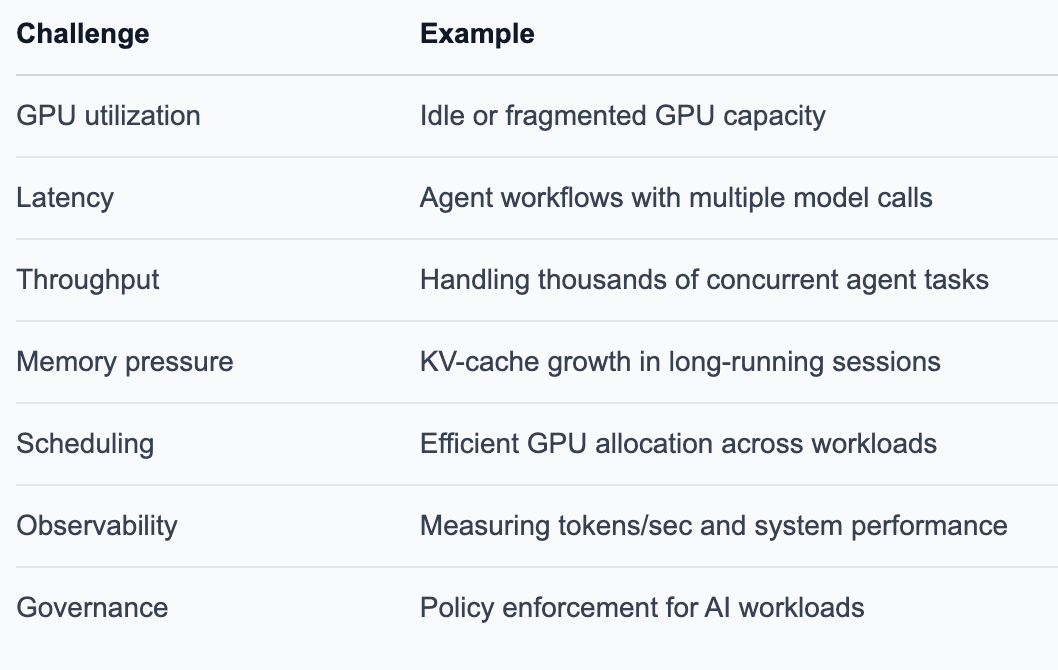
These problems are fundamentally infrastructure problems rather than model problems. The more sophisticated the AI application becomes, the more critical the infrastructure layer becomes.
Lessons From Previous Technology Waves
History shows that many major technology waves follow a similar pattern. Early innovation tends to occur at the application or technology breakthrough layer, but long-term competitive advantage often shifts toward platform infrastructure. Examples include:
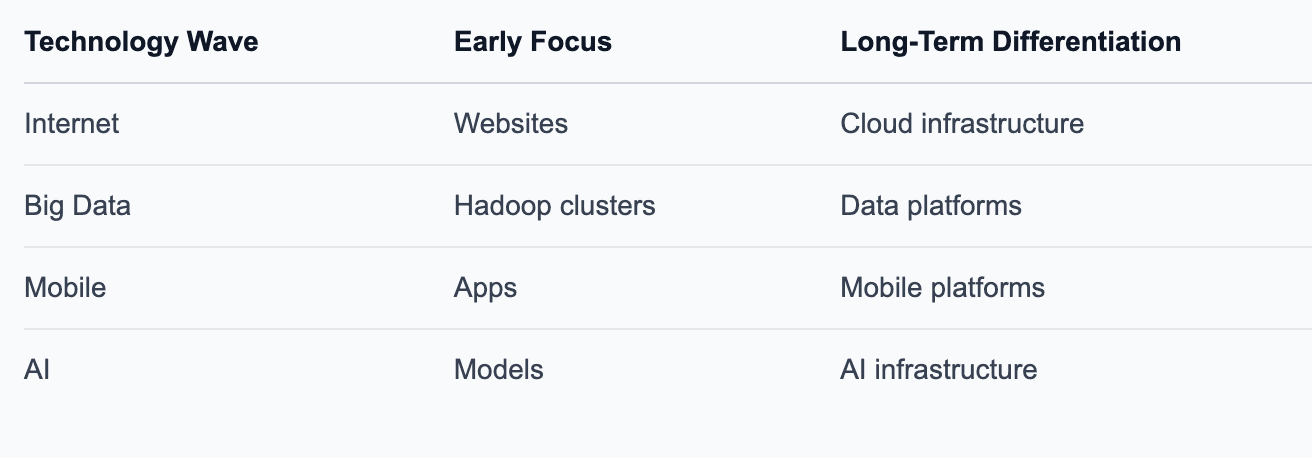
Infrastructure becomes strategic because it governs performance, economics, and scalability across entire ecosystems. Companies that control the infrastructure layer often shape how the entire ecosystem evolves.
Understanding Competitive Advantage Through the Resource-Based View
To better understand where durable competitive advantage comes from, strategy researchers often turn to the Resource-Based View (RBV) of the firm. RBV argues that long-term competitive advantage arises from resources and capabilities that a firm controls internally rather than simply from market positioning. Examples of such resources include:
proprietary technology
specialized infrastructure
operational expertise
engineering capabilities
organizational processes
The key question RBV asks is: Which capabilities allow a company to outperform competitors in a way that is difficult to replicate?
In the context of AI, the important question becomes: Which capabilities will create a durable advantage as the industry evolves from models to agent-based systems? To evaluate this, strategy research often uses the VRIO framework.
Evaluating AI Capabilities Through the VRIO Framework
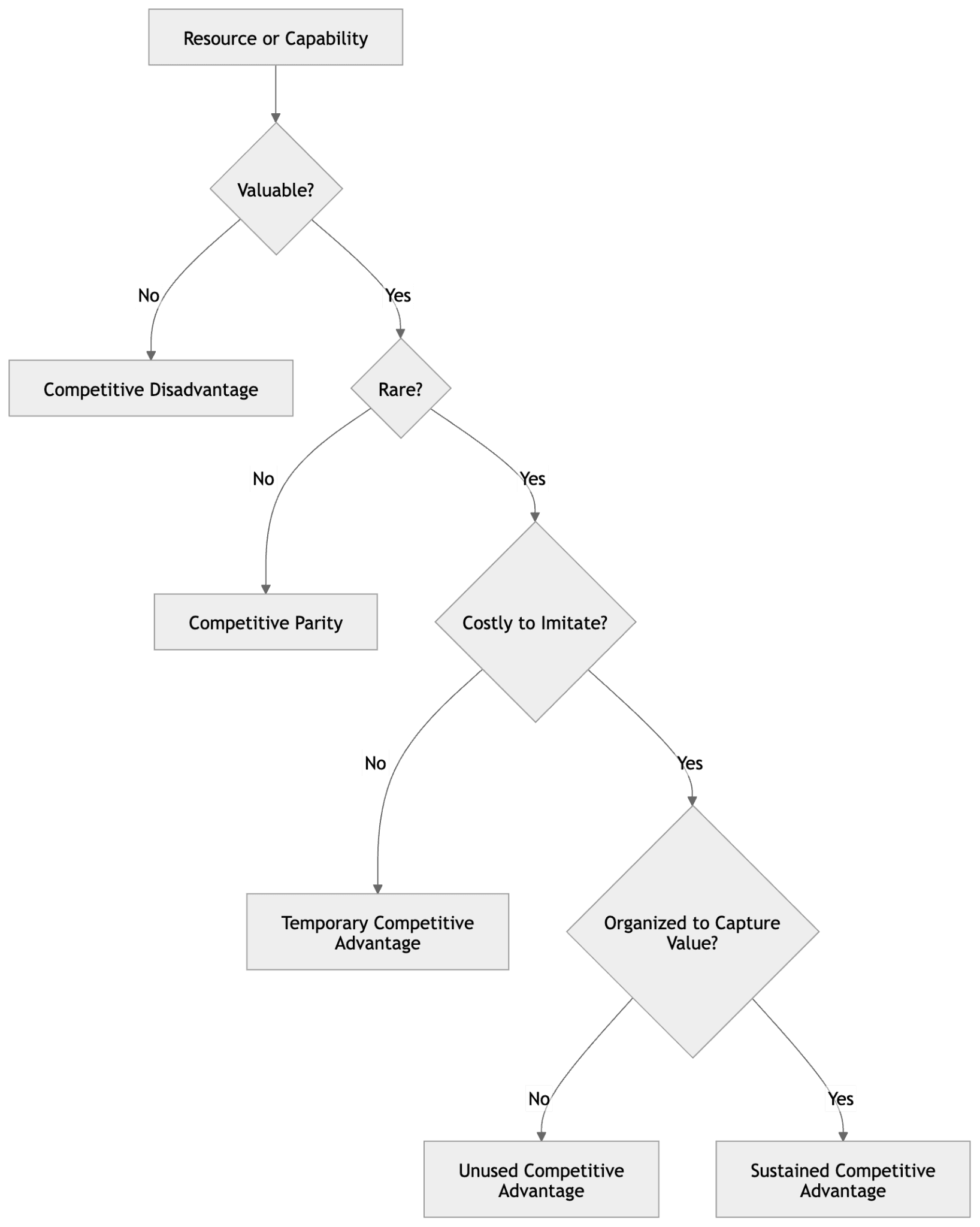
The VRIO framework evaluates whether a resource can produce sustained competitive advantage. VRIO stands for:
Value — Does the capability create economic value?
Rarity — Is it scarce among competitors?
Imitability — Is it difficult to replicate?
Organization — Is the company structured to capture the value?
When all four conditions are satisfied, a capability can create sustained competitive advantage.
Applying VRIO to the AI Landscape
Applying the VRIO framework to AI capabilities reveals an interesting pattern.
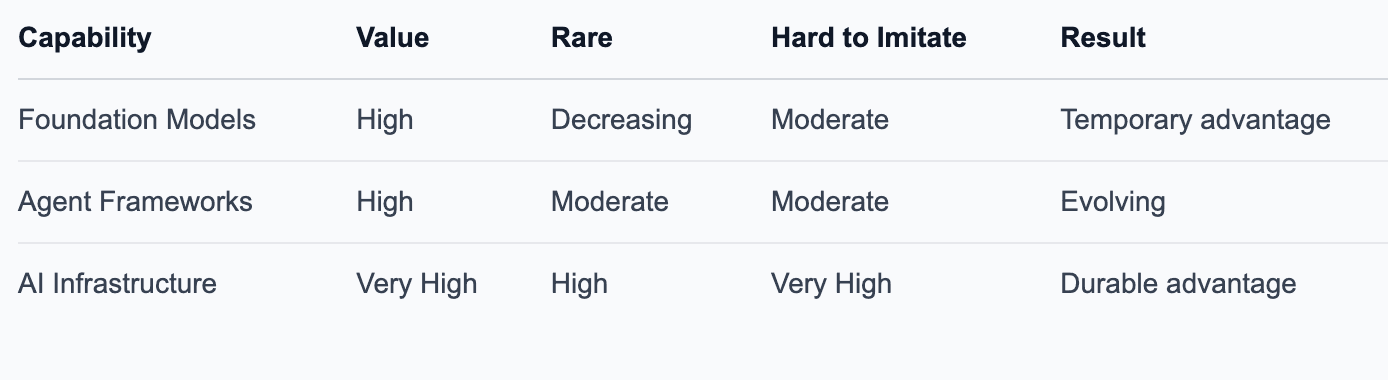
Foundation models remain valuable, but they are becoming increasingly accessible through open models, hosted APIs, and fine-tuning platforms. Infrastructure, however, has characteristics that make it a powerful competitive advantage:
it touches every workload
it controls operational cost
it improves with scale and operational data
it becomes deeply embedded in production systems
These properties make infrastructure significantly harder to replicate once an organization develops expertise and operational maturity.
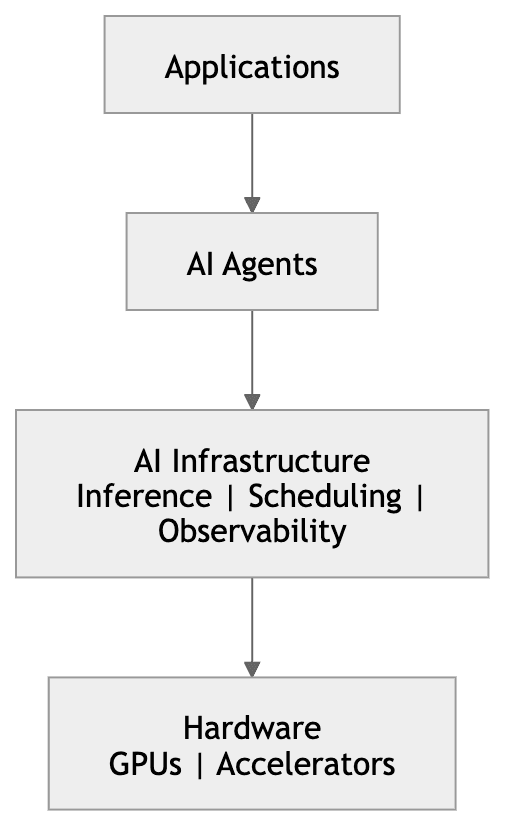
The Emerging AI Infrastructure Stack
As AI systems evolve toward agent-based architectures, several new infrastructure layers are emerging.
Inference infrastructure
model serving
batching
memory optimization
runtime efficiency
GPU orchestration
multi-tenant GPU scheduling
predictive capacity scaling
resource fragmentation control
Agent infrastructure
tool execution environments
workflow orchestration
agent identity and permissions
AI observability
token usage tracking
GPU utilization metrics
latency and throughput monitoring
Together, these layers form the operational backbone of modern AI systems.
What This Means for the Next Phase of AI
The next phase of AI development may be shaped by two forces working together:
Agents will drive application innovation. Infrastructure will determine operational success.
As AI systems become more complex and autonomous, the infrastructure supporting them will increasingly determine cost efficiency, system performance, scalability and reliability. In other words, the durable competitive moat may lie not just in what AI systems can do, but in how efficiently they can run.
Closing Thought
The AI revolution is often framed as a race to build better models. But the industry is beginning to recognize that models alone are not enough. As AI evolves from models to agents, the systems required to operate those agents at scale will become increasingly important.
The next frontier of AI may not simply be smarter models—but smarter infrastructure.